A Rigorous Approach to
Long-Term Shark Science.
From clearly defined questions to evidence that remains useful over time.
Shark Search begins with the scientific question. Research methods, monitoring frameworks and analytical tools are selected according to what the project is designed to understand, rather than applying one method across every species, location or research context.
Field observations, environmental information, photographic records, biometric identification and scientific review are connected within a structured framework. This allows individual encounters to contribute to broader records across animals, populations, locations and time.
Uncertainty, contributor permissions, attribution and responsible data governance are incorporated throughout the process. This helps protect scientific integrity while supporting long-term monitoring, collaboration and evidence-based conservation.

FIELD RESEARCH
Observation grounded
in context.
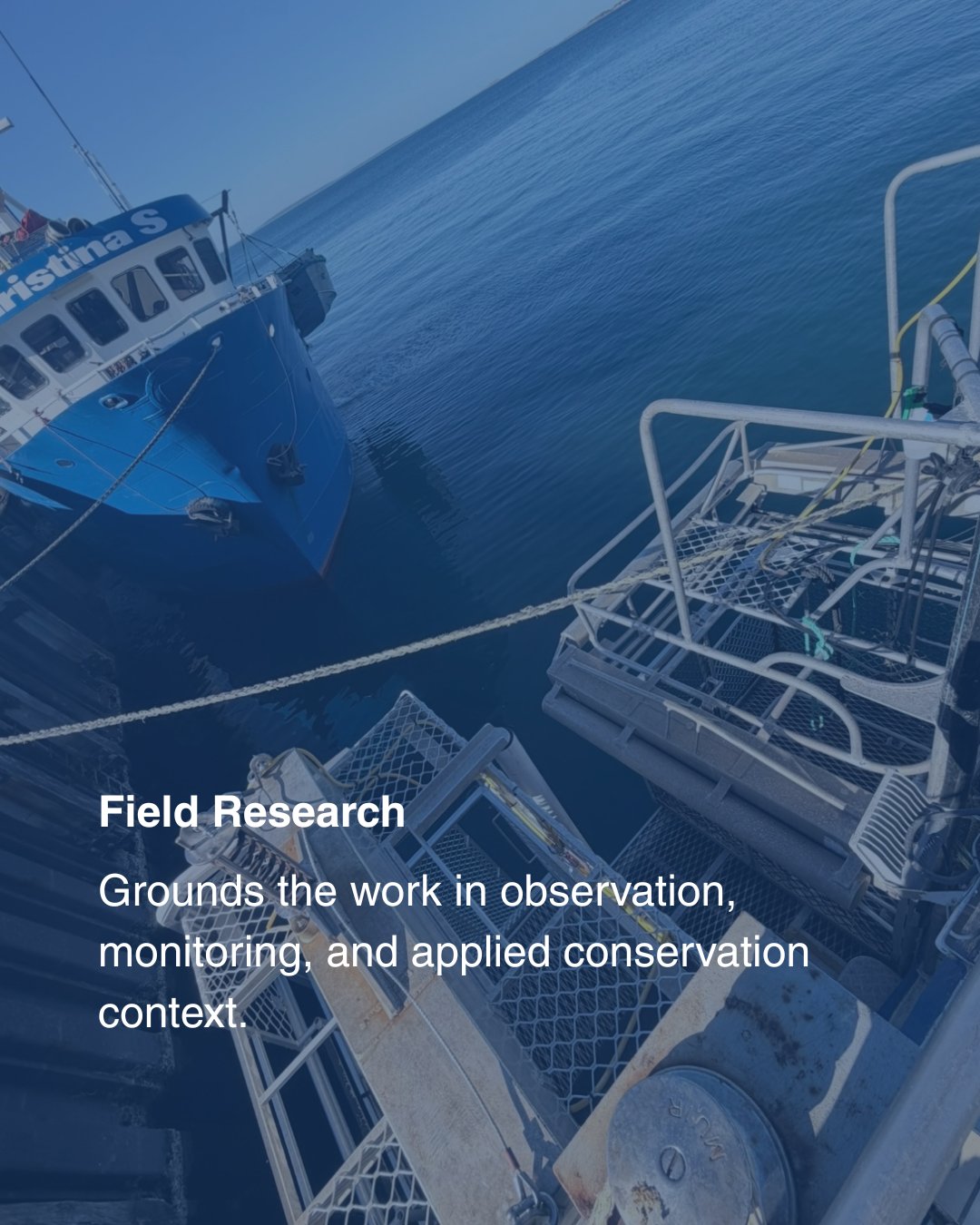
Field research connects shark encounters with the environmental, behavioural and spatial context needed to understand what those observations mean.
Depending on the research question, structured observations may include location, habitat, behaviour, environmental conditions, photographic evidence and repeated encounters.
Consistent methods allow records to be compared across sites and time, supporting investigation of occurrence, habitat use, movement, recurrence and broader population patterns.
FROM FIELDWORK TO EVIDENCE
Observe
Document encounters together with relevant environmental, behavioural and spatial context.
Record
Use consistent methods so observations remain comparable across sites and time.
Interpret
Evaluate resulting evidence within appropriate scientific and conservation frameworks.
RESEARCH DESIGN
The question determines
the method.
Research design translates a scientific question into a practical framework for observation, measurement and analysis.
Field observation, photographic monitoring, environmental information, individual identification and analytical methods are selected according to the species, location, research objective and context of each project.
Where research continues over time, consistent methods help preserve comparability across encounters, sites and seasons, allowing records to remain scientifically interpretable and useful for broader research questions.
FROM QUESTION TO METHOD
Define
Establish the scientific question and the evidence required to address it.
Design
Select methods suited to the species, location and research objective.
Build
Create consistent records that remain comparable and useful over time.



INDIVIDUAL IDENTIFICATION
Recognising sharks across encounters and time.
Photographic identification allows repeated encounters to be connected to individual sharks, building records that can develop across locations and over time.
Distinctive characteristics such as natural markings, fin morphology, pigmentation, scars and species-specific body features can provide evidence for individual recognition.
Identification evidence is considered alongside image quality, feature visibility, encounter metadata and scientific review before confirmed re-sightings are incorporated into an individual record.
Identification is treated as scientific evidence, not simply an image match.